Ureteroscopy with Laser Lithotripsy for The Treatment of Kidney Stones
Ureteroscopy with laser lithotripsy is used to break up kidney stones by that were not passed and remain lodged in the ureter. During this procedure a laser beam is applied directly to the stone to break it into small pieces and passed easily.
Nearly gone are the days when kidney stone surgery involved actual incisions. Now, with rare exception, kidney stones are managed most commonly with either Extracorporeal Shock Wave Lithotripsy, or ESWL, (whereby sound waves are fired at stones so that they crumble and pass) or with ureteroscopy.
Ureteroscopy will be used primarily for stones that are being passed unsuccessfully and are therefore lodged in the ureter, the tube that connects the kidney to the bladder. An ureteroscope is a very narrow scope, either rigid or flexible, that allows Urologists to travel up the ureter to the stone and see it on a video monitor via fiberoptics. Here, instead of using sound waves as the energy source to crumble the stone gradually, ureteroscopy uses the energy pulse of a laser beam, applied directly to the stone, to chip it away into tiny pieces. Ureteroscopy is thus more direct, and therefore more successful than ESWL, and there will be fewer stone fragments to pass.
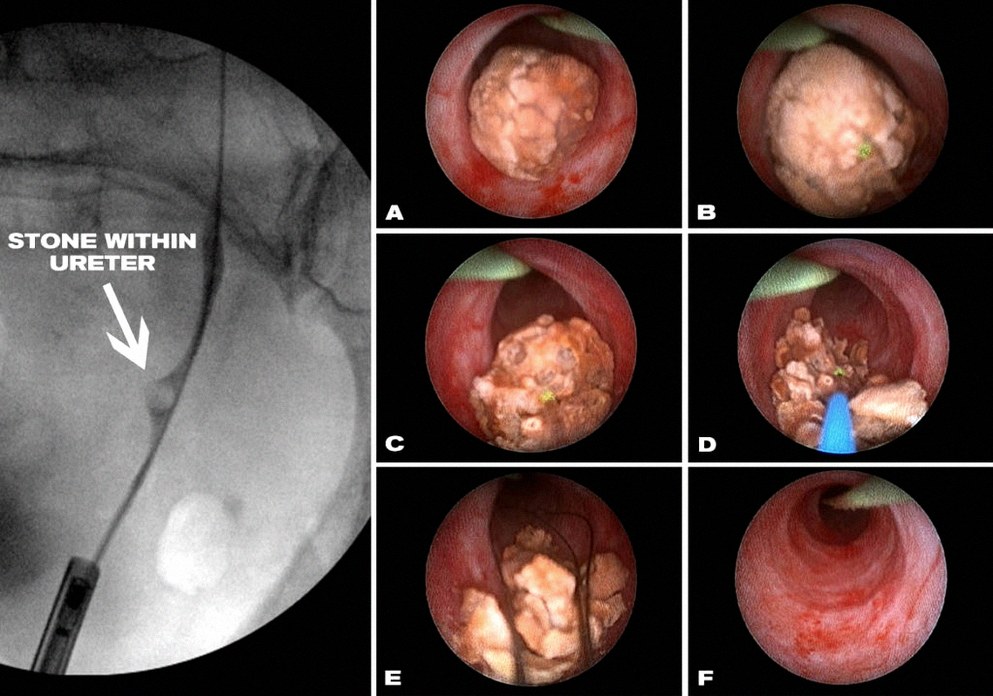
Uretoroscopy with Laser Lithotripsy
A: Stone initially visualized through scope. B: Preparing to laser stone. C & D: Laser pulverizing stone. E: Removal of stone fragments with basket. F: Ureter now stone-free.
Often the patient has a choice between ESWL and ureteroscopy. ESWL will be more commonly employed for stones in the kidney and ureteroscopy more often used for ureteral stones, but these are not fixed rules at all. Patients will often prefer ESWL as it is less invasive in that typically no scopes are inserted into the patient’s bladder, and no stent is placed. However, often when faced with the disparity in stone free rates and the finality uieteroscopy often provides, the patient chooses ureteroscopy. Sometimes, certain stones will require more than one procedure, or a combination of procedures.
Stenting
Stents are temporary plastic tubes that are inserted into the ureter from the bladder to the kidney. Their purpose is to keep the ureter open after treatment of a stone so that urine may flow, and to allow the edema and inflammation present due to the stone and as a result of the stone treatment to resolve. A stent is placed after the procedure is finished while the patient is still asleep, and will be removed in the office usually the following week in a quick office procedure. The stent is entirely internal and cannot be seen.
Stents are most commonly very well tolerated. 80% of patients will perhaps only report very mild bladder irritation, mild flank pain while urinating, and will nearly always see blood in their urine. All of these signs and symptoms are perfectly normal and will resolve after the stent is removed. Another 15% or see will have more complaints attributable to the stent such as moderate abdominal pain, perhaps constipation, and more irritative bladder symptoms. No more than 5% of patients however will feel that these symptoms are more severe, thus not allowing them to get back to work or function normally. In these cases, we will pull the stent earlier for them in the office as a responsible compromise.
Risks of Ureteroscopy
Ureteroscopy is a safe procedure, usually performed in an outpatient surgical center setting. Risks include of course pain, infection and bleeding. Very rare risks included ureteral perforation or injury, or subsequent scarring called stricturing. The main thing for patients to be concerned about after any stone procedure would be a fever. Fevers after a stone procedure could trigger bacteremia (bacteria in the blood stream) and even sepsis. If you are experiencing an emergency that cannot be accommodated by an office visit the same or the next business day in either of our locations, please dial 911 or go to your nearest or favorite emergency room and ensure that Dr. Grant or Dr. Tobon are contacted to take part in your care. As a reminder, UroMax physicians have privileges at Reston Hospital Center, Holy Cross Hospital Silver Spring, and Holy Cross Hospital Germantown.


Frequently Asked Questions
How do I schedule an appointment at UrologyMax?
Schedule online or call 1-800-876-6299 or use our online booking. Same-day and telehealth appointments are available.
Does UrologyMax accept insurance?
UrologyMax works with most major insurance plans. Contact our billing team at 1-800-876-6299 to verify your coverage before your visit.
What should I bring to my first urology appointment?
Bring your insurance card, photo ID, medication list, prior test results, and a completed patient intake form available on our website.
Are telehealth consultations available?
Yes. UrologyMax offers telehealth consultations for many urological concerns, including ED prescriptions, follow-up visits, and second opinions.
What makes UrologyMax different from other urology practices?
UrologyMax combines advanced robotic surgery capabilities with discreet online ED medication ordering and a patient-first approach to comprehensive urological care.