Extracorporeal Shock Wave Lithotripsy (ESWL) for Kidney Stone Treatment
Extracorporeal Shock Wave Lithotripsy (ESWL) is a non-invasive treatment for kidney stones that uses sound waves to pulverize kidney stones within the body. ESWL is performed in an outpatient setting and the entire procedure is performed on the outside of the body.
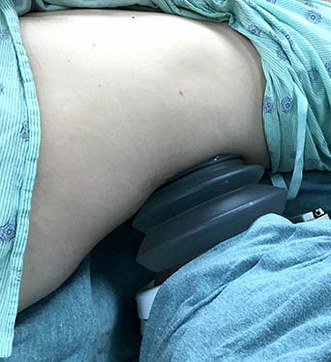
ESWL treatment head treating left kidney
Extracorporeal Shock Wave Lithotripsy (ESWL) is the application of sound waves to pulverize stones within the body from outside the body.
ESWL was a revolutionary technology that was introduced to the treatment of kidney stones in the 1980s.
Before its introduction, stones were removed through incisions, which were far more invasive. The original ESWL devices utilized a water bath to transmit the sound waves to the body, but now lithotripters are far smaller. Now, they are typically mobile devices that use gel pads placed against the body for shock wave transmission.
ESWL for Ureteral Stones
ESWL can be used for ureteral stones but is far more efficacious for stones that reside in the kidney. Now, ureteroscopy has supplanted ESWL as the most commonly performed procedure for ureteral stones and delivers a high success rate. However, ESWL is typically performed without a ureteral stent, so some patients will still choose this approach over ureteroscopy despite a lower success rate.
What To Expect From Your ESWL Procedure
ESWL is usually done in an outpatient surgical center setting, as is done by the surgeons at UrologyMax. The procedure requires anesthesia and takes approximately 45 minutes. Patients will wake up with little pain.
With a typical stone sized between 5-10 mm in the kidney, one can expect an approximately 90% success rate. Occasionally the stone will not fragment, will fragment but will not move, or a fragment will become impacted in the ureter. Such patients may require a subsequent procedure to become stone free. Occasionally in the setting of a large stone, a second ESWL is offered.
There is often bruising over the flank/kidney that was treated. Blood in the urine almost always occurs and should be of little concern.
Risks of ESWL
Complications with a lithotripsy are rare but do occur. There can be bleeding around the kidney, especially if the patient has a history of taking blood thinners or has out of control hypertension, infection, obstruction due to a fragment, or failure of the procedure.
Pain after a lithotripsy typically suggests good fragmentation and stone passage. Here, as long as the pain is tolerable, one should just wait a day or two for the stones to pass. Otherwise, If you are experiencing an emergency that cannot be accommodated by an office visit the same or the next business day in either of our locations, please dial 911 or go to your nearest or favorite emergency room and ensure that Dr. Grant or Dr. Tobon are contacted to take part in your care. As a reminder, UroMax physicians have privileges at Reston Hospital Center, Holy Cross Hospital Silver Spring, and Holy Cross Hospital Germantown.
Your doctor will ask you to return at a predetermined interval with a radiographic study to determine the success or failure of the ESWL. You will be asked to bring your CD of that study to your visit.


Frequently Asked Questions
How do I schedule an appointment at UrologyMax?
Schedule online or call 1-800-876-6299 or use our online booking. Same-day and telehealth appointments are available.
Does UrologyMax accept insurance?
UrologyMax works with most major insurance plans. Contact our billing team at 1-800-876-6299 to verify your coverage before your visit.
What should I bring to my first urology appointment?
Bring your insurance card, photo ID, medication list, prior test results, and a completed patient intake form available on our website.
Are telehealth consultations available?
Yes. UrologyMax offers telehealth consultations for many urological concerns, including ED prescriptions, follow-up visits, and second opinions.
What makes UrologyMax different from other urology practices?
UrologyMax combines advanced robotic surgery capabilities with discreet online ED medication ordering and a patient-first approach to comprehensive urological care.