Benign Prostatic Hyperplasia (BPH): Symptoms, Medications & Minimally Invasive Treatments
Click Here to Watch an On-Demand Webinar on BPH with Dr. Grant
Urinary symptoms that creep up gradually over months or years are among the most common reasons men seek urological evaluation. The typical presentation begins in a man's late 40s or 50s: trips to the bathroom become more frequent, the urinary stream weakens and hesitates, the sense of urgency becomes harder to defer, and nighttime awakenings for voiding — nocturia — begin to disrupt sleep. These changes accumulate slowly enough that many men normalize them as inevitable aging, delaying care for years while the condition quietly progresses. sometimes cause alarm. Most men want to make sure this is not a sign of prostate cancer, which it almost never is, or to be sure they do not have another problem such as an infection or bladder cancer. All of these things are almost always quickly ruled out during an office visit. Most of these patients are seeking reassurance and not necessarily treatment.
BPH is no more a disease than graying hair, but in some men can gradually and eventually become a significant detractor to their quality of life. BPH can, in its most severe form, cause not only medical problems such as urinary retention, bladder stones, and infections but also life-threatening kidney failure and serious infections.
The underlying pathology in the vast majority of men presenting with these lower urinary tract symptoms is benign prostatic hyperplasia (BPH) — a non-malignant proliferation of both glandular and stromal elements within the transition zone of the prostate, driven primarily by the intraprostatic conversion of testosterone to dihydrotestosterone (DHT) via the enzyme 5-alpha reductase. Prostate growth begins in most men around age 40 and accelerates progressively with age. By age 60, histological evidence of BPH is present in more than 50% of men; by the ninth decade, that proportion exceeds 90%. Importantly, BPH is not a precancerous condition and does not increase the risk of prostate cancer, though both conditions may coexist and both elevate PSA — a distinction that requires careful clinical interpretation.
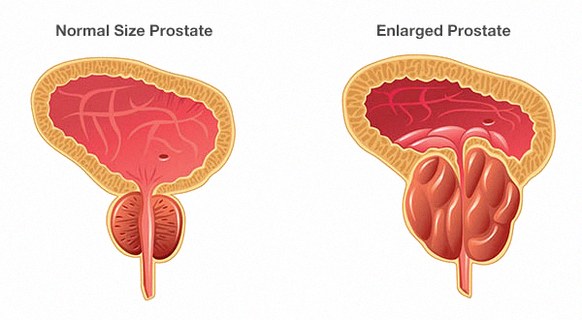
Because the urethra passes directly through the central zone of the prostate, any enlargement of the gland mechanically compresses the urinary channel. The bladder responds to this increasing resistance with compensatory hypertrophy — its muscular wall thickens and becomes progressively less compliant, producing the urgency and overactivity that characterizes obstructive BPH. Over time, the overworked detrusor muscle decompensates, bladder emptying becomes incomplete, residual urine accumulates, and the risk of acute urinary retention, bladder stones, recurrent infections, and ultimately upper tract damage rises substantially.der gets overactive when it is asked to work too hard, thus leading to urgency and frequency; the enlarged prostate obstructs the bladder and therefore blocks urine flow, slows the stream, and leads to higher and higher amounts of urine left over after one is finished urinating. This leftover urine is called urinary retention. If retention gets severe enough, a man may acutely need a catheter to empty his bladder. But, except for situations where the bladder never becomes irritable called silent prostatism, a man’s symptoms usually alert him to a problem far before this occurs.
At UrologyMax, every patient presenting with lower urinary tract symptoms completes the validated International Prostate Symptom Score (IPSS) — a seven-question instrument that systematically quantifies frequency, urgency, nocturia, stream quality, hesitancy, intermittency, and sensation of incomplete emptying, along with a global quality-of-life question. A score of 0–7 indicates mild symptoms; 8–19 moderate; 20–35 severe. This questionnaire is not merely administrative: it objectively tracks treatment response over time and directly informs the treatment conversation. Alongside IPSS, our standard evaluation includes digital rectal examination, PSA testing, urinalysis with culture, post-void residual by ultrasound, and uroflow measurement. This comprehensive assessment allows confident differentiation of BPH from other causes of LUTS — including overactive bladder, urethral stricture, detrusor underactivity, or neurogenic dysfunction.
When to Seek Treatment for BPH
Our pharmacological approach to BPH is evidence-based, graduated, and tailored to individual prostate size, symptom profile, and patient preference. Alpha-1 adrenergic receptor blockers — including tamsulosin, alfuzosin, and silodosin — represent the universal first-line medical option. By relaxing smooth muscle in the prostate and bladder neck, they reduce outlet resistance and typically produce noticeable symptom improvement within 3–7 days. They are well tolerated by most men, with the principal side effects being orthostatic hypotension and, in some patients, retrograde ejaculation. For men with demonstrably enlarged prostates (greater than 40 cc on imaging), adding a 5-alpha reductase inhibitor (finasteride or dutasteride) provides the additional benefit of progressive prostate volume reduction over 6–12 months — reducing the risk of acute urinary retention by 57% and the need for surgical intervention by 48% compared to alpha-blocker monotherapy in the landmark MTOPS trial.
Other medications, called 5-alpha-reductase inhibitors, are also available. They are used less frequently, as they tend to be less effective as alpha-blockers, take 3-6 months to take full effect, and literature shows them to be useful only in the case of very large prostates. So, if a man has progressed through an alpha blocker, or wants better relief, he may be offered a second drug but will also at that point be offered a procedure.
 We see BPH as a progressive problem and feel that its treatment should take a similar stepwise approach. Almost always, by the time a man is seeking a procedure, he has first noticed symptoms but did not seek treatment. He then started with an alpha blocker as the least invasive treatment. We would be remiss if we did not mention herbal or alternative remedies here, as they are heavily advertised and often an option readily offered and available for BPH. We do not discourage their use, but it seems clear that their effects have more to do with a placebo effect that is achieved by simply believing they will work more than actual efficacy. There have been several studies, practically none well-designed, that show that such herbal formulations work better than “sugar pills”. Patients are very welcome to try them. Regardless of why they help, if they provide adequate symptom relief, they may be a reasonable solution. However, we find that once a patient is telling us that an FDA-approved medication is failing, typically this will not be a lasting solution.
BPH Procedures / Surgeries
If, after trying one or more medications or remedies, a patient gets to the point where he feels that their urinary problem is bothersome to the point that they have decided that they want the problem solved and not simply ameliorated, it is time to consider a procedure. There are many procedures to choose from, but they basically fall into two categories: Procedures designed to be done under local anesthesia in the office, that are quick, easy, and low risk, and procedures that must be done in a surgery center or hospital under anesthesia and may or may not require an overnight stay. Dr. Grant calls these either office procedures or operating room procedures. The fundamental difference between these two groups of procedural/surgical solutions is the convenience, the success rate, and the risk involved.
Some urologists will perform office procedures in their surgical center facilities, but we feel that this defeats the purpose, and negates the primary advantage of choosing this class of procedure – convenience. All of these are developed and designed to be done under simple local anesthesia in the office, typically take 15 minutes or less to perform, usually offer a 75-85% success rate, and have minimal to very low risk of complications. Today, the two most heavily marketed procedures are the Urolift and the Rezum. The predecessor to the Rezum procedure is the TUNA/Prostiva procedure which we still find very useful for some clinical situations where a less intense thermotherapy would be best applied. One may still find Cooled Thermotherapy, or Microwave procedures being performed but in large part, this is no longer offered except in the rare circumstance of an elderly patient who is catheter dependent.
Please see our procedures section for a much more detailed description of each of these, and to learn why, after personally performing all of these here at UrologyMax, we have decided to use Rezum as our primary office procedure with the application of TUNA/Prostiva for certain anatomies and clinical circumstances.
If one fails a minimally invasive office procedure, has more serious medical complications of BPH necessitating a more aggressive relief of obstruction, or simply wants to skip over office therapies in favor of something with a more immediate result with a higher success rate, an operating room procedure will be offered.
Office procedures have distinct advantages. In our practice, most patients will choose these over more aggressive options as part of the step-wise approach that we employ. However, as stated, office procedures have a lower success rate of typically between 75 and 85 percent. We accept a lower success rate due to their simplicity and safety profile. In men where these fail, where a patient demands a higher success rate, or if there are anatomic considerations or medical complications of BPH that demand a more aggressive approach, there are several options in the category we call operating room procedures, These will typically offer at least a 95% success rate and durability of 7 years or more compared to the typical durability of five years of a successful office procedure. However, these will require anesthesia and the preparation that goes into that. Operating room procedures will have an approximate 1% chance of incontinence after the procedure and will almost certainly create a situation where there will be no semen with ejaculation. Other risks would include bleeding and infection. The gold standard here is called the TURP, or trans-urethral resection of the prostate. Although the instrumentation is far more advanced and safe now, the TURP has been the mainstay operation in this category for over 50 years. When the prostate is quite large, perhaps 80 grams or higher, Dr. Grant will offer his patients a Robotic Simple Prostatectomy as the safest, quickest solution. HOLEP, or Holmium laser enucleation of the prostate, is employed by a few Urologists in this same setting, but due to Dr. Grant’s skill with robotic surgery, he does not find this to be the safest solution in his hands here. Robotic Simple Prostatectomy and HOLEP are two excellent ways of treating very large prostates, both with their own pros and cons, and there is no clear winner. Both require a special skill set so typically an expert in one does not do the other, and most urologists do neither. Aquablation is a relatively new device that allows such urologists to offer a solution for very large prostates, but the bleeding risk is severe as compared to Robotic Simple Prostatectomy or HOLEP and therefore is not at all the safest approach in Dr. Grant’s hands given his vast experience with robotic surgery. Laser procedures, such as Green Light Laser, and others, are included in this category because they require anesthesia. Although marketed as minimally invasive approaches they still have all the same risks of a TURP with less efficacy and durability. Often side effects are worse than a TURP with laser procedures such as the Green Light. For this reason, we perform Green Light Laser procedures only in special circumstances, not as our mainstay operating room procedure. We usually see office procedures as better solutions in the setting of initial treatment for an average-sized prostate. Again, please go to our Procedures section of this site to learn much more.
Regardless of the procedure or operation recommended, the goal is the same – to solve a man’s annoying BPH problem in the simplest, safest way possible while still offering high success rates. All men will undergo office testing to determine the right procedure for them, and all reasonable solutions will be outlined and offered by the physicians at UrologyMax.


Frequently Asked Questions
What is BPH?
Benign prostatic hyperplasia (BPH) is a non-cancerous enlargement of the prostate that restricts urine flow and causes frequent, urgent, or incomplete urination.
What is REZUM therapy?
REZUM uses water vapor to ablate excess prostate tissue. It is an in-office, minimally invasive procedure with a quick recovery and long-lasting symptom relief.
Is BPH the same as prostate cancer?
No. BPH is benign (non-cancerous). However, BPH and prostate cancer can coexist, so proper evaluation including PSA testing is essential.
What medications treat BPH?
Alpha-blockers (tamsulosin) relax prostate muscles. 5-alpha reductase inhibitors (finasteride) shrink the prostate. Combination therapy is often most effective.
When is surgery needed for BPH?
Surgery is recommended when medications fail or cause side effects, or when BPH causes urinary retention, kidney damage, or recurrent infections.