Bladder Cancer: Diagnosis, Staging & Expert Treatment
Click Here to Watch Dr. Grant’s Presentation on Bladder Cancer Screening
Bladder cancer is one of the most commonly treated urological malignancies — fourth in incidence among men and ninth among women in the United States, with approximately 83,000 new cases diagnosed each year. While receiving a cancer diagnosis is always alarming, it is important to understand that the vast majority of bladder cancers are detected at an early, superficial stage where they are highly treatable and rarely life-threatening. The key to favorable outcomes lies in prompt, thorough evaluation and consistent surveillance.
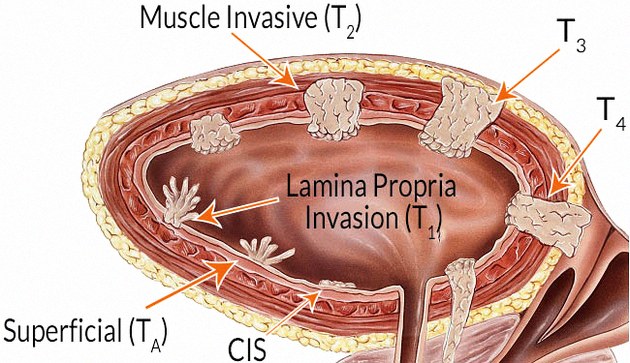
Hematuria — blood visible in the urine either grossly (visible to the naked eye) or microscopically (detected on urinalysis) — is the presenting sign in approximately 85% of bladder cancer cases. A critical and often underappreciated point: gross hematuria is frequently painless, which can falsely reassure patients that nothing is seriously wrong. Any episode of unexplained hematuria in an adult — regardless of volume, duration, or the absence of pain — demands prompt urological evaluation including cystoscopy and upper tract imaging. Delaying evaluation of hematuria is one of the most common missed opportunities for early bladder cancer detection.
Almost all bladder cancers are called transitional cell carcinoma. Over 90% of such tumors will be formed in the bladder, but they can occur anywhere along the lining of the urinary tract including the ureter or in the kidney, or renal pelvis.
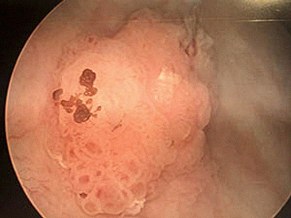
A typical bladder tumor
The overwhelming majority of bladder cancers originate from the transitional epithelial cells lining the inner surface of the bladder — a tissue type called urothelium. These are classified as urothelial carcinoma (formerly transitional cell carcinoma), which accounts for over 90% of all bladder malignancies. The bladder is by far the most common site of origin, but urothelial carcinoma can also arise in the renal pelvis, ureter, and urethra, collectively requiring coordinated upper and lower urinary tract surveillance. Rarer variants include squamous cell carcinoma (associated with chronic bladder irritation or schistosomiasis) and adenocarcinoma.
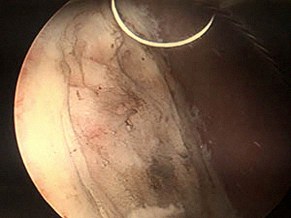
Bladder wall post-resection
When a bladder tumor is found, it is nearly always cancerous or malignant. However, two properties must be known about the tumor to know how dangerous it is, and what the management will be. We will first need to perform a relatively minor procedure called a TURBT, or trans-urethral resection of the bladder tumor. This will be a procedure, performed in a surgery center or hospital setting based on extent, whereby a scope called a resectoscope is placed into the bladder. This special scope allows us to shave off the tumor from the surface of the bladder wall, and to shave deep enough also to provide tissues from the deeper layers of the bladder called the lamina propria and the deep muscle layers. This procedure is done as an outpatient or at times will require an overnight stay. Aside from some annoyance with a urinary catheter, some irritative urinary symptoms afterward, and blood in the urine, a TURBT carries with it the rare risks of bladder perforation or injury to the ureteral orifice, where the kidney connects to the bladder. The patient will come to our office to review the pathology report from their TURBT a few days after the procedure and typically after they have removed their own catheter as instructed, and it is at that time that we will know what we need to know regarding the tumor. By definition, a CT scan will have already been performed that hopefully rules out spread or metastasis.
The pathology report will tell us about two main things: the grade of the tumor and whether the tumor is invasive or not. The grade will usually be called simply high grade or low grade. The higher the grade, the more aggressive the tumor is. However, the property that will have the biggest impact on risk, and affect treatment the most, is whether the tumor is invasive or not. Invasive tumors can metastasize, and with some exceptions, non-invasive or superficial tumors do not. There is a third finding that must be mentioned here as well called carcinoma-in-situ, or CIS. CIS is a very ominous finding, as although it is considered a pre-malignant lesion, it almost always will form a high-grade, invasive tumor. Thus, ironically, much more would be made of a finding of a small area of CIS, even though it is pre-malignant than a large, low-grade, non-invasive bladder tumor. The finding of CIS will always warrant further treatment.
Removal of one’s bladder is a very involved, major operation done in specialized centers in most cases. Dr. Grant has been one of a select few Urologists in the area who performs complex urinary tract reconstruction to handle urination in a continent manner after bladder removal.
If a primary tumor is found to be deeply invasive, there is at least a 50% chance of metastasis that has occurred, even if it cannot be found. Such tumors that are invasive into the deep muscle will necessitate the removal of the bladder. Contemporary thinking is that giving chemotherapy prior to bladder removal may be beneficial in such cases (neoadjuvant chemotherapy). Dr. Grant will always arrange a visit to an oncologist to be offered this approach but sees logic in some cases in proceeding with surgery directly and offering chemotherapy after the surgery based on the pathologic findings (adjuvant chemotherapy). Removal of one’s bladder is a very involved, major operation done in specialized centers in most cases. Dr. Grant has performed such operations regularly throughout his career. He is one of a few Urologists in the area who has performed complex urinary tract reconstruction to handle urination in a continent manner after bladder removal. In men, Dr. Grant will recommend a Studer ileal neobladder, whereas in women his preferred reconstruction is called an Indiana pouch. Many patients will opt for a simpler approach called an ileal conduit whereby the urine will flow into an ostomy bag placed on the patient’s abdomen. In men, removal of the prostate is usually also performed when removing the bladder, but in selected cases, Dr. Grant will perform a prostate-sparing cystectomy in an effort to preserve erectile function and potentially retain ejaculation. Feel free to view a video of Dr. Grant performing such a surgery found in the common procedures section of this site.
Most tumors are superficial (not invasive) and low-grade. These tumors are commonly only managed by performing regular cystoscopies and cytologies in the office, with removal when found.
But muscle invasive tumors are the exception, not the rule. Most tumors are superficial (not invasive) and low grade. These tumors are commonly only managed by performing regular cystoscopies and cytologies in the office, with removal when found. At times, we may recommend further treatment in the form of a course of instilling chemotherapy into one’s bladder (intra-vesical chemotherapy) in order to decrease the risks of recurrence or progression to a more dangerous tumor, but this is usually reserved for patients with recurrent disease. Such low risk tumors are often termed “nuisance tumors”, as they represent a nuisance but are not particularly dangerous. Low risk tumors do have a high recurrence rate, but they rarely progress to be dangerous invasive or high grade tumors.
It is the high grade non-invasive tumor, or the early invasive tumor going into the lamina propria only, or when CIS is found that mandates treatment beyond simply surveillance cystoscopy. Such tumors, and especially CIS, not only have a high recurrence rate, but they also have a high progression rate. A tumor that is high grade and invasive to the lamina propria is especially dangerous. Such tumors can already have metastasized and must be treated aggressively. These tumors are called T1G3 tumors. Some even advocate cystectomy when these are found, but more typical management involves automatic repeat resection to be sure that deeper invasion is not seen, along with a course of intravesical chemotherapy. CIS will always warrant intravesical chemotherapy, as do high grade tumors typically.
The two most common agents used for intravesical chemotherapy historically are called BCG and Mitomycin-C, although now a drug called Gemcitabine has largely supplanted the use of Mitomycin-C due to its lower risk of severe irritative symptoms and low cost. BCG is actually an organism that is related to the organism that causes tuberculosis. It induces an immune response in the bladder and is best thought of as immunotherapy. Mitomycin-C is a standard chemotherapy agent as is Gemcitabine. Also now added to that list is Docetaxel which is given in combination with Gemcitabine when BCG fails as a final thing to try before offering cystectomy. BCG is always given in the setting of CIS and is most often given for T1G3 tumors and high grade tumors. Mitomycin-C and Gemcitabine are more typically given in cases of lower risk tumor recurrence, but there is significant crossover with these agents and these are not fixed rules. BCG is given once a week in the office for six weeks, and at times as part of a “maintenance” protocol whereby in our practice it is given for three weeks, every six months, for three years. The side effects of BCG are largely irritative symptoms in the bladder. A very rare risk of giving BCG is if it gets into the bloodstream. In such a case, as it is similar to tuberculosis, can be a very severe infection even leading to sepsis. Fortunately, this is almost never seen, but it is why we may skip a dose if the bladder has not yet healed adequately or if infection is suspected before giving it. Mitomycin-C is typically given in the office every week for eight weeks; Gemcitabine is every week for six weeks. Side effects are also typically irritative and inflammatory in nature. Occasionally Mitomycin-C or Gemcitabine is given as a single dose at the time of tumor resection in order to decrease recurrence.
Dr. Grant is highly experienced in all areas of bladder cancer management and would be happy to discuss any of this further with you.


Frequently Asked Questions
How do I schedule an appointment at UrologyMax?
Schedule online or call 1-800-876-6299 or use our online booking. Same-day and telehealth appointments are available.
Does UrologyMax accept insurance?
UrologyMax works with most major insurance plans. Contact our billing team at 1-800-876-6299 to verify your coverage before your visit.
What should I bring to my first urology appointment?
Bring your insurance card, photo ID, medication list, prior test results, and a completed patient intake form available on our website.
Are telehealth consultations available?
Yes. UrologyMax offers telehealth consultations for many urological concerns, including ED prescriptions, follow-up visits, and second opinions.
What makes UrologyMax different from other urology practices?
UrologyMax combines advanced robotic surgery capabilities with discreet online ED medication ordering and a patient-first approach to comprehensive urological care.