Urethral Strictures: Causes, Symptoms & Reconstructive Treatment
Urethral stricture disease is a frequently encountered — and frequently underdiagnosed — condition in which cicatricial (scar tissue) narrowing of the urethra restricts or obstructs the normal passage of urine. The urethra in men spans from the bladder neck to the urethral meatus at the tip of the penis, traversing the prostate, urogenital diaphragm, perineum, and penile shaft along the way. Each anatomical segment has its own injury pattern and treatment implications, making thorough localization of the stricture essential to proper management.
The bulbar urethra — the segment spanning the perineum between the external urethral sphincter and the penile scrotal junction — is the most commonly affected site in stricture disease, accounting for approximately 50% of all cases. Men bear their body weight on this area when seated, making it particularly vulnerable to perineal straddle injuries (bicycle accidents, falls astride a hard object). Inflammatory conditions and prior instrumentation also contribute. Bulbar strictures typically respond well to urethroplasty when appropriately performed by an experienced reconstructive urologist.
The penile urethra — also called the pendulous or anterior urethra — is the segment extending from the penoscrotal junction to just proximal to the glans. Strictures at this location are less common than bulbar strictures and are frequently associated with inflammatory conditions such as lichen sclerosus (balanitis xerotica obliterans), prior hypospadias repair, or catheter-related injury. Penile strictures tend to require more complex reconstruction, as the surrounding spongiosal tissue is often affected, limiting the use of native tissue grafts and necessitating buccal mucosal substitution urethroplasty in many cases.
Finally, the area of the urethra just under the glans (head of the penis), just before the meatus, is called the fossa navicularis. Strictures in this area are seen often after a catheter or scope has been placed in a man’s urethra, for instance after a TURP. These strictures often respond to simple dilation, and if recurrent can easily be managed by self-dilation. On rare occasions, reconstructive surgery is indicated.
The symptomatic presentation of urethral stricture parallels that of bladder outlet obstruction from any cause: a weak, narrowed urinary stream; hesitancy and straining to initiate voiding; post-void dribbling; urinary frequency and urgency secondary to incomplete bladder emptying; and occasionally recurrent urinary tract infections or epididymitis driven by urinary stasis. In younger men, post-void dribbling is a particularly characteristic and often overlooked sign. Diagnosis is confirmed by urine flow rate measurement, post-void residual assessment, and retrograde urethrogram — the gold standard imaging study for defining stricture location, length, and caliber prior to treatment planning.
The simplest treatment is dilation of the stricture. This is always performed with a fossa navicularis stricture due to its ease and effectiveness, or a membraneous stricture as this may be the only way to open the channel without causing incontinence. Otherwise, we employ dilation very sparingly because the recurrence rate after dilation is 80-90%, and each dilation can lengthen or worsen the stricture thus complicating its treatment. Our preferred approach for the initial presentation of a urethral stricture is to perform a minor procedure, under anesthesia, called a direct vision internal urethrotomy (DVIU). Here, the recurrence rate is still high at approximately 50% but is still far less than dilation and may be less traumatic to the urethra. The stricture is cut with a knife or laser using a scope.
Sometimes an injection of medicine (mitomycin-C or other) is made into the cut base of the stricture as well to try to decrease the recurrence rate. There are devices now in their initial stages of popularization that dilate the stricture and try to impregnate the stricture with these medicines as well, but superiority to a simple DVIU and injection has not at all been proven yet and they are very expensive. After the DVIU, a patient will typically wear a urinary catheter for a few days after a DVIU and should notice a dramatic improvement in their stream right away. Then, it is a function of being on the lookout for recurrence.
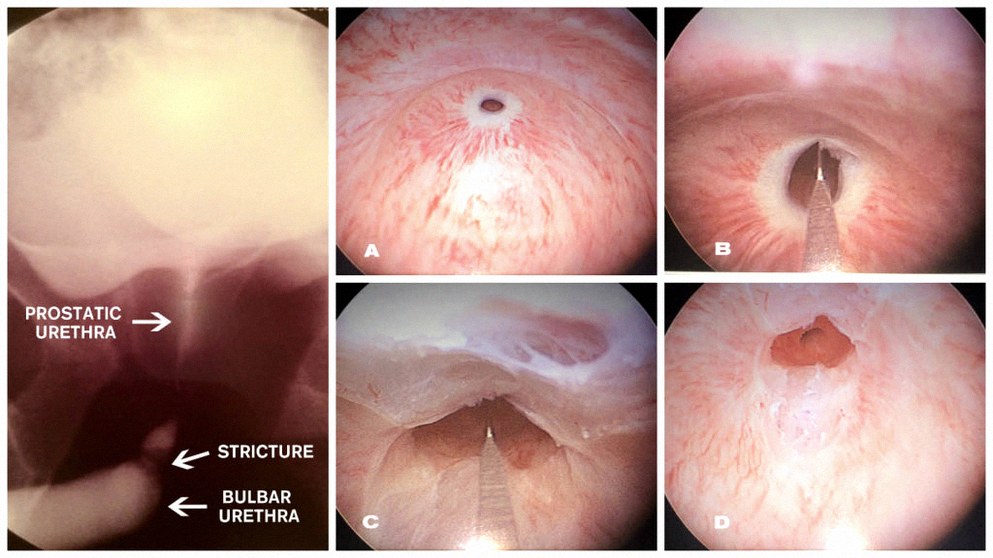
Internal Urethrotomy
A: Bulbar urethral stricture. B: Initial incision of stricture. C: Completion of incision.
D: Stricture now open, urinary sphincter shown.
If a stricture does recur, more aggressive solutions will be offered. A patient can always choose to undergo another DVIU, or even dilation, but at this point, such a patient must expect recurrence rates of over 90%, even with DVIU. If recurrence occurs after the first DVIU, Dr. Grant will offer a more permanent solution called a urethroplasty, a reconstructive procedure that Dr. Grant performs. A urethroplasty is a surgical repair of a stricture whereby the affected area is dissected and either fully excised with the good ends brought together with sutures (an anastomotic urethroplasty), or incised and the gap in the tubular urethra filled with tissue. Today, the preferred tissue to use is the lining of one’s cheek, called buccal mucosa. Over the years, many different tissue techniques have been used, including bladder mucosa, scrotal skin, foreskin, penile skin, and others. Buccal mucosa has largely replaced those tissues as the graft of choice and the introduction of its use greatly simplified and improved the treatment of recurrent urethral strictures.
For bulbar strictures less than 2cm, Dr. Grant will sometimes perform an anastomotic urethroplasty, whereas longer or anterior strictures will almost always call for a graft. With a buccal mucosa urethroplasty, the patient will have stitches inside the side of their mouth where the graft was taken which will dissolve over a few days. The feeling is similar to having bitten one’s cheek. The pain is not severe, and this site heals very rapidly. In addition, a catheter will have to stay in the urethra draining the bladder urine while the graft heals for 2-3 weeks. A urethroplasty is an outpatient procedure in Dr. Grant’s hands. Depending on the location and severity of the stricture a urethroplasty can afford a 93% success rate or better with no recurrence. Although this is more of an actual reconstructive surgery, with some mild recovery and the imposition of wearing a catheter strapped to one’s leg for a few weeks, the payoff of having this frustrating, recurrent problem removed from one’s life so that repeat lifelong procedures are avoided is invaluable and almost invariably makes a urethroplasty well worth undergoing in the long term.
Dr. Grant has been performing this type of surgery in the DC area for 25 years. He would be happy to see you if you suspect or have been diagnosed with a urethral stricture during an office consultation and offer the best approach for you.


Frequently Asked Questions
How do I schedule an appointment at UrologyMax?
Schedule online or call 1-800-876-6299 or use our online booking. Same-day and telehealth appointments are available.
Does UrologyMax accept insurance?
UrologyMax works with most major insurance plans. Contact our billing team at 1-800-876-6299 to verify your coverage before your visit.
What should I bring to my first urology appointment?
Bring your insurance card, photo ID, medication list, prior test results, and a completed patient intake form available on our website.
Are telehealth consultations available?
Yes. UrologyMax offers telehealth consultations for many urological concerns, including ED prescriptions, follow-up visits, and second opinions.
What makes UrologyMax different from other urology practices?
UrologyMax combines advanced robotic surgery capabilities with discreet online ED medication ordering and a patient-first approach to comprehensive urological care.